What Are Traditional Business Management Methods?
For decades, businesses depended on a set of traditional and manual approaches to keep daily operations running smoothly. Traditional approaches commonly include:
Manual record-keeping using paper or spreadsheets.
Coordinated through in-person meetings and phone calls.
Using separate tools for accounting, inventory, and customer administration.
Physical storage for documents and bills.
Manual data analysis and reporting might be time-consuming.
Manual payslips are time-consuming, error-prone, and possess significant compliance risks.
While these methods have been effective for decades, they have disadvantages such as inefficiency, a larger risk of errors, and scaling issues with the growth of business.
Introducing Aline Business Management Software
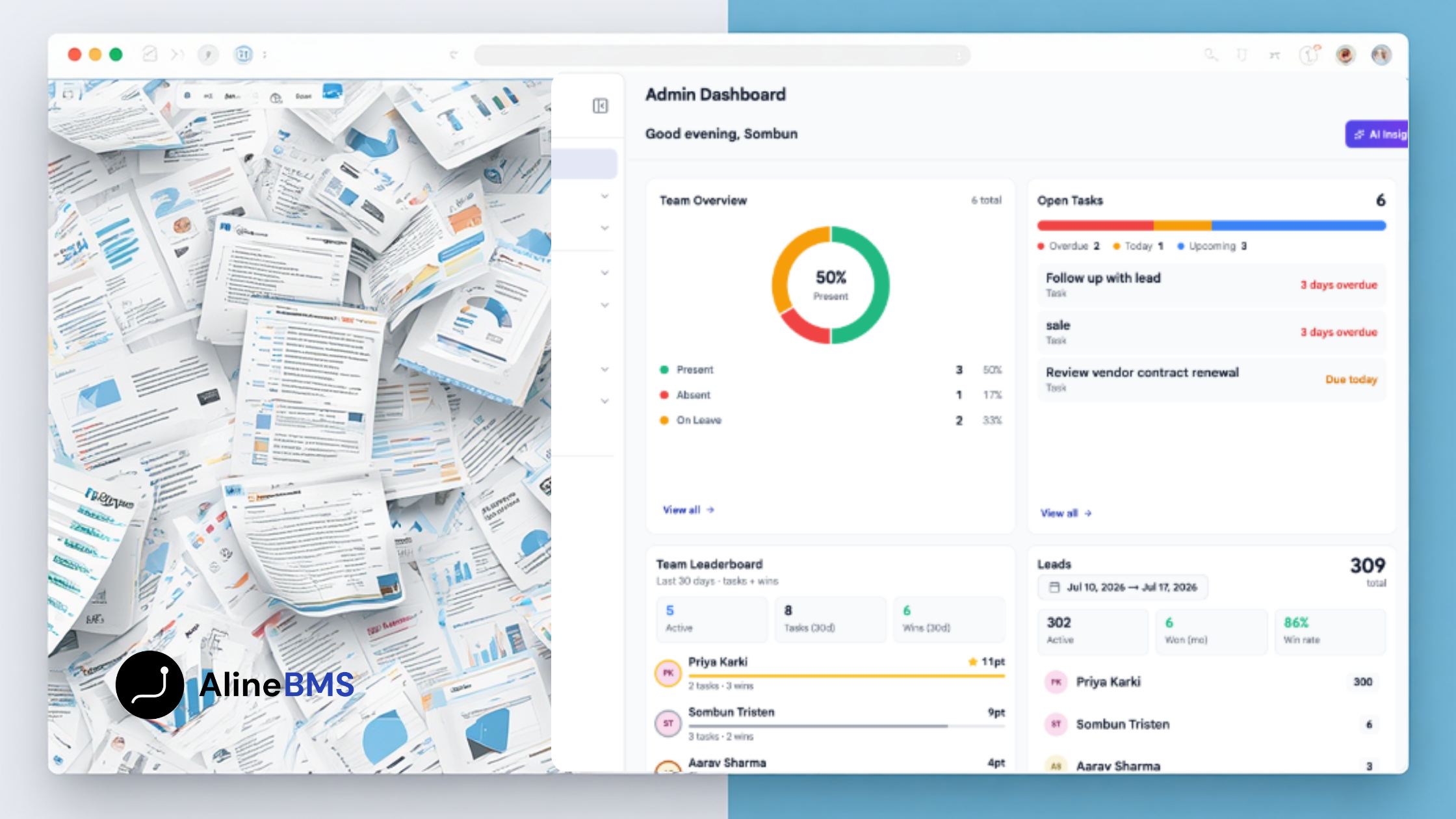
Aline is a business management solution that simplifies and unifies business platforms. It combines project management, sales, HR suite and payroll, customer relationship management (CRM), and team collaboration features all in one platform. It integrates all business functions in one place.
Key Differences Between Aline and Traditional Methods
1. Centralized Management vs. Fragmented Systems
Aline: Provides a unified dashboard for real-time project, financial, and communication management.
Traditional: Use several separate tools and physical files, making it difficult to maintain monitoring.
2. Automation vs. Manual Processes
Aline: Automates repetitive operations like invoicing, reminders, and reporting to save time and prevent errors
Traditional: Manually updating records and reports increases the possibility of errors.
3. Accessibility vs. Physical Constraints
Aline: With cloud-based access, your team can collaborate from anywhere and at any time.
Traditional: Physical documents and local files restrict access to certain locations and times.
4. Real-Time Data vs. Delayed Insights
Aline: Offers real-time statistics and performance data for quick decision-making.
Traditional: Data compilation and analysis are time-consuming processes that cause crucial business decisions to be delayed.
5. Scalability vs. Static Capacity
Aline: Scalable features and user options allow for easy adaptability to corporate expansion.
Traditional: Scaling requires more human labor and may incur additional costs for tools and storage.
Why Choose Aline?
Increased Efficiency: Automate routine tasks and centralize your workflow.
Better Collaboration: Keep your team connected with integrated communication tools.
Cost-Effectiveness: Reduce overhead from paper, storage, and multiple software subscriptions.
Improved Accuracy: Minimize human errors with automated processes.
Payroll Automation: Generate and distribute automated payslips to simplify tax deductions and net pay.
Attendance and leave management: Track employee work hours, absences, and time-off requests to ensure accurate payroll.
Future-Ready: Prepare your business for growth with scalable technology.
Conclusion
While traditional business management tools have their benefits, modern challenges need modern solutions. Aline business management software is a powerful, effective, and scalable option that allows businesses to work smarter, not harder. Switching to Aline can help you streamline your processes, save time, and gain vital business insights that traditional ways cannot match. Modern businesses need modern solutions to succeed.
If you're ready to take your business management to the next level, switching to Aline could be the game-changer you need.


